
Pruning Operations
With arboriculture it's certainly not all or nothing!
There are numerous pruning procedures that can be undertaken to achieve specific criteria; creating more light, opening up a view, risk reduction or keeping the height and spread of the canopy under control.
If removing a tree completely is too drastic for you then there are plenty of options available. Likewise, if your tree/s fall within a conservation area or have TPO's on them you may still be allowed to carry out pruning operations. In this instance the works would have to be under the guidance of the Peak District National Park Tree Officers. Here at HVTC we have a brilliant and longstanding relationship working closely with the National Park authorities. We will arrange site meetings with the Tree Officers and handle all the relevant permissions as part of our service.
Please browse the following section which explains some of these procedures and what they can achieve.
NB when viewing our galleries on your mobile device or tablet please click on the images to access the full view and descriptions.

Crown Raise
Crown raising refers to the removal of lower branches to increase the vertical distance between the base of the tree and the canopy. The main focus of this pruning operation is on the canopy itself. Therefore, depending on the branch structure this may not mean removing all the branches below the line of the desired raise as this may disturb the canopy higher up.
This procedure can be used to; let more light through underneath the canopy, raise the canopy from over garden boarders, paths and driveways, If your trees are next to highway then this can be used to achieve the five meter clearance required by the authorities or, to open up a view and let more light through underneath the canopy
 Crown raise on a mature Sycamore.The work carried out on this tree was multifaceted. One aim was to open up the beautiful view over Hathersage. |  Crown raise on a mature Sycamore.From this angle you can see the raise on the left hand side of the tree was more severe to open up the view. The right hand side was more sympatric to achieve the five meter clearance over the road required by the highway specification. A crown raise generally aims to achieve a level plateau all the way around the canopy. |  Crown raising work on Tissington Estate.Crown raisin and additional pruning operations were carried out on an avenue of seventy Lime trees on Tissington estate. The specification of the raising work was to achieve a level plateau throughout the avenue of trees leading to the estate. |
|---|
Crown Thin
Crown thinning refers to the process of systematically removing selected branches from every limb of the tree. The aim of this is to reduce the density of the canopy's foliage.
The two predominant reasons for a crown thin are; to reduce the weight and sail effect (the stress put on limbs due to the foliage catching the wind like a sail) for safety reasons and, to allow more light to pernitrate through the canopy itself. It is important to note that the size and shape of the canopy is unaltered during the thinning process, therefore, retaining the natural shape of the tree but allowing much more light through.
A crown thin is usually expressed as a percentage, for example a 20% thin may be advised for safety reasons or, a 50% thin may be suggested to improve light. The gallery below shows examples of a crown thins undertaken in Baslow and Hathersage to meet different work specifications.
 Copper Beech before crown thinning.In this instance it was actually two copper beech that had grown into a single canopy. As you can see the canopy is extremely dense and obscuring a great deal of light from that area of the garden and the rooms on that side of the house. |  Copper Beech after crown thinning.As you can see after the crown thin the canopy is a significant reduction in the canopy's density. This allows much more dappled light to pernitrate through the canopy thus brightening up the affected rooms in the house and that area of the garden. |  View from underneath part way through the thinning process.At this stage of the thinning operation the left hand side of the canopy has been thinned and the right has not been touched yet. |
|---|---|---|
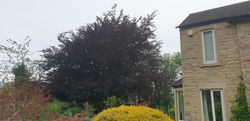 Before thinning.From this angle you can appreciate the amount of shade being cast onto that side of the house and area of the garden. |  After thinning.The canopy remains the same overall size and shape but now allows much more light through. |  Before and after crown thin on a SycamoreA more sympathetic thin tagetting one specific limb to alleviate the weight and sail effect for safety reasons. |
 Thinning for safety.The large right hand limb on this mature Sycamore was showing signs of stress so an independent tree report was conducted. A 25% targeted crown thin on this limb only was advised. This alleviated some weight from the limb and reduced the sail affect, ultimately reducing the risk of limb failure. |
Crown Reduction
As the name suggests a crown reduction is a procedure whereby the overall height and width of the canopy is reduced. This is achieved by removing the tips of branches and pruning them back to suitable replacement growth points.
There comes a point where many trees outgrow the spaces they are in or become overpowering within gardens and next to properties. A reduction is the perfect choice for those who do not wish to remove a tree altogether but would like it to be smaller. How well a tree lends itself to a reduction differs between species and individual specimens. There is usually an inverse relationship between the percentage of the reduction and the aesthetics of the finished product, therefore it is usually a case of finding a happy medium.
Reductions are also used as a method of risk reduction, especially on species prone to shedding limbs and mature trees that have reached the nature stage of growth where limbs begin to fail.
 Willow Reduction Holmesfield (height only)The owner of this beautiful Willow has safety concerns after a similar tree failed in high winds. They wished to retain a natural looking tree so it was suggested a reduction in height would remove much of the stain on the limbs by decreasing the sail effect on the extremities of the branches higher up. | 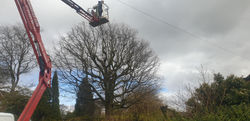 Beech Reduction HathersageAs per the customers specification we performed a sympathetic all round reduction to prevent the tree from overpowering the garden. Around 10ft was removed from the top and the sides were pruned back accordingly leaving a lovely natural shape to their Beech tree. |  Willow Reduction Calver (height only)This feature tree of the village undergoes a reduction every five to seven years, the height is reduced back to where done preciously due to safety concerns. |
|---|---|---|
 Birch Reduction Bakewell |